



Previous coverage: Beyond the Headlines: Protecting Youth from Algorithmic Extremism · The Viral Confrontation San Diego’s Mayor Didn’t Want You to See
When political violence strikes a marginalized community, the institutional response follows a well-worn script.
High-visibility police cruisers temporarily flank the perimeters of local houses of worship. Press conferences dominate the news cycle. Public officials deploy localized, sanitizing language: “isolated incident,” “troubled individuals,” “suspected hate crime.”
Authorities waste invaluable time compensating for catastrophic systems failures and patching outdated bureaucratic protocols. And then, if enough pressure builds, the truth emerges, and the fractures within the structures and systems we depend on are exposed.
Three weeks after three worshippers were murdered at the Islamic Center of San Diego, that is exactly what happened. Under sustained community pressure and the weight of a 75-page manifesto explicitly designed to trigger a race war, authorities scrambled to react. Finally, the FBI stepped in with a reclassification: domestic terrorism. Not just a hate crime.
But by the time the paperwork cleared, the attention economy had already exacted its tax. Naturally, the collective focus has migrated to the next crisis, the next viral conflict, or the next cycle of outrage. The state’s updated vocabulary arrives as a quiet postscript to a story the public has already stopped reading, leaving the bureaucratic machine to hollowly declare a victory of definition long after the world has moved on.
Then the news trucks packed up. The patrol cars disappeared. And the underlying pipelines that radicalize, arm, and mobilize violent actors remain entirely functional. Not metaphorically, but literally, utilizing the exact same fractured legal, security, and digital infrastructures—and the hosting providers and lobbying networks that insulate hate from accountability.
This structural delay creates a dangerous psychological trap. Because the institutional upgrade happens so late, the only words that truly stick in the public consciousness are the initial, sanitized headlines — circulated before the machinery of Big Tech and mainstream media has already pulled our attention elsewhere. This warps how we understand and process political violence in three specific ways:
Cementing the Wrong Frame. The public internalizes the early, flawed narrative, “isolated incident”, as definitive truth. The structural reality “domestic terrorism,” “transnational accelerationist network”, is lost entirely.
The Manufactured Attention Deficit. We are never allowed enough time to sit with a tragedy, sit with the grief, or critically analyze the failure. The attention economy demands constant novelty to maintain profitability.
A Cycle of Strategic Amnesia. Media and tech infrastructures work in tandem to keep us perpetually moving forward. By starvation of time, they ensure structural failures never stay relevant long enough to generate sustained public interest or spark real systemic accountability.
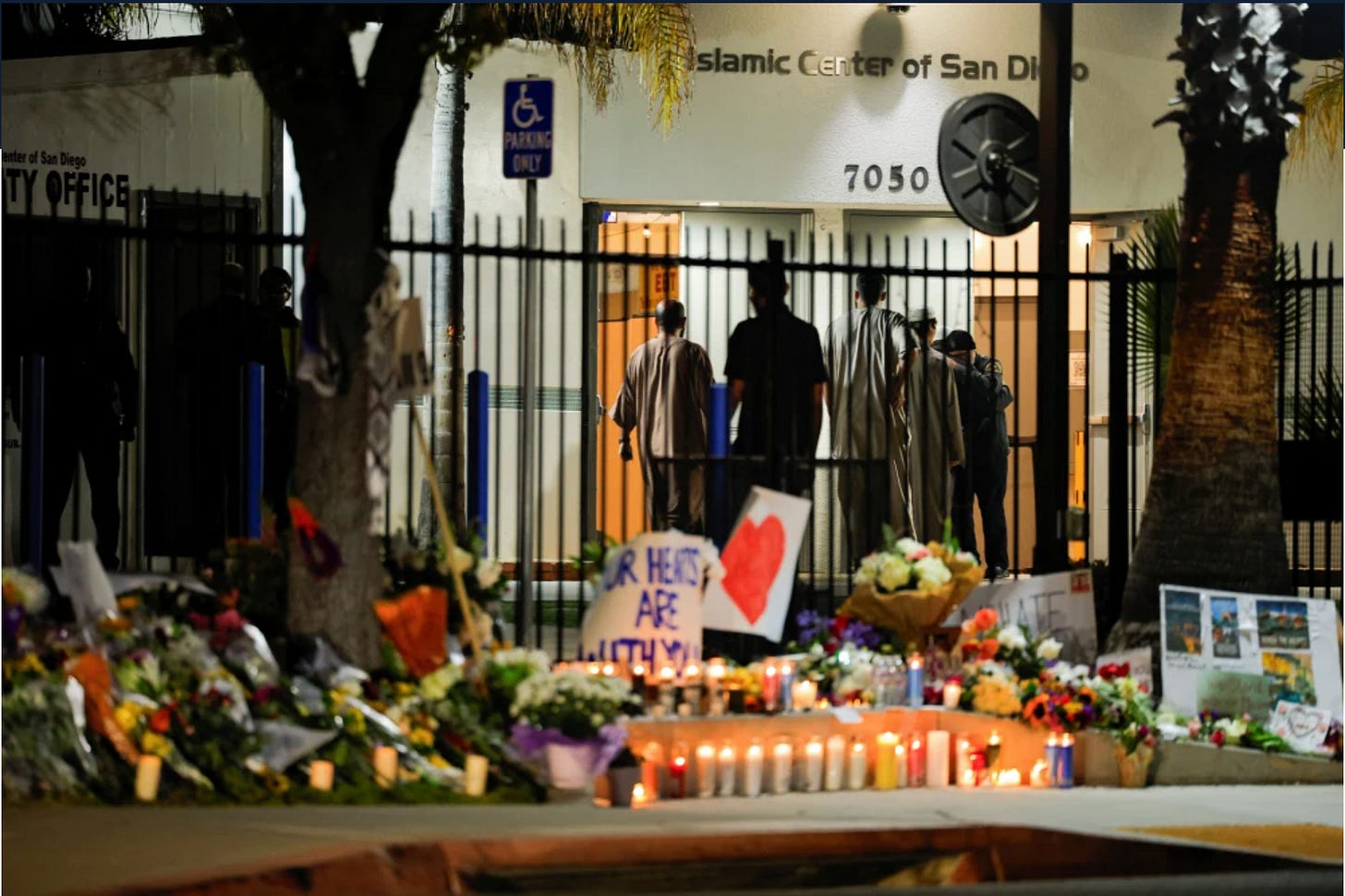
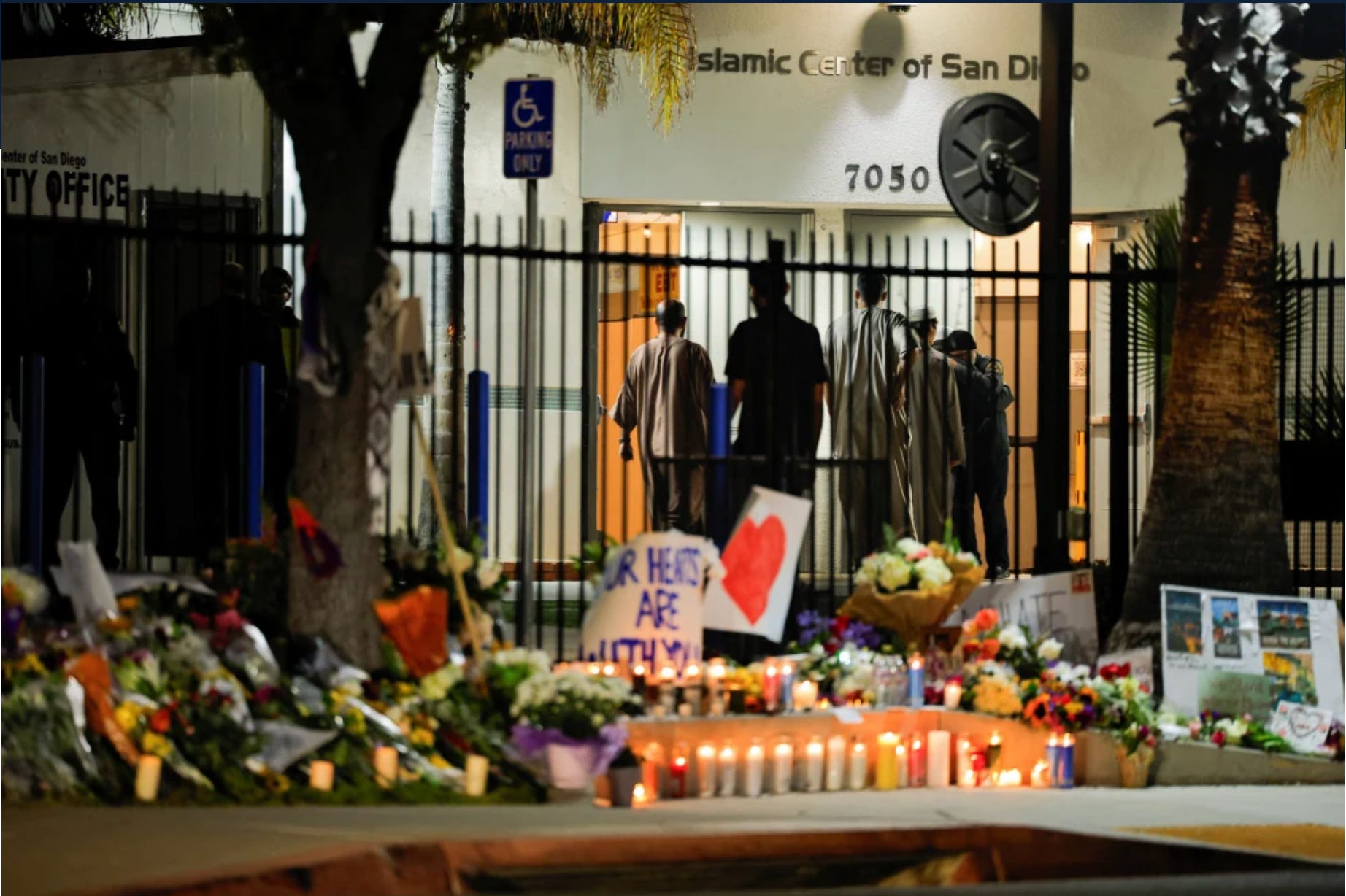
The Islamic Center of San Diego following the shooting that killed three people. Mike Blake / Reuters
Call It What It Is, And Then Go Further
Classifying this attack as domestic terrorism matters. Words carry weight. The designation formally elevates what happened to what it actually was: an ideological, coordinated assault on our collective security, incubated on domestic soil, inspired by an international accelerationist movement with a shared canon and a shared playbook.1
But symbolism does not stop bullets.
The FBI’s reclassification exposes a terrifying structural reality: our national security architecture and legal frameworks are fundamentally unequipped not just for a decentralized digital era, but for the era of ideological convergence.
Our counter-terrorism tools were built to detect rigid, uniform doctrines. They look for card-carrying members of specific, legacy hate groups. But modern online radicalization no longer requires ideological purity. Instead, the pipeline operates like an algorithmic “salad bar,” where broken individuals mix and match seemingly contradictory grievances.
In digital spaces, we now see a fluid convergence where militant accelerationism weaves seamlessly together with incel subcultures, radical anti-government conspiracism, hyper-nihilism, and eco-fascism. They are bound together not by a shared utopia, but by a shared desire for total systemic collapse.2
Our legal framework is structurally blind to this synthesis. It wastes critical time trying to pigeonhole an attacker into a singular, bureaucratic box—debating whether an event was a “hate crime” or “political terrorism”—while the pipeline itself has already moved past ideology entirely, unifying disparate factions under a singular, gamified playbook of mass violence.3
This profound mismatch between 20th-century static law and 21st-century fluid terror manifests in three devastating operational blind spots:
The Teeth Gap: When an attacker is captured alive, federal prosecutors can leverage hate crime statutes to give the system legal teeth. But because there is no comprehensive domestic terrorism statute with preventative criminal charges for decentralized actors, the FBI’s reclassification carries zero immediate legal utility. It cannot preemptively punish, it cannot deter cell networks, and it cannot dynamically unseal preventative warrants against borderless entities.
The Retroactive Trap: When perpetrators commit suicide at the scene—as Clark and Vazquez did, and as Christchurch's Tarrant explicitly instructed followers to do—the "domestic terrorism" label degrades entirely into an exercise in clerical data tracking. The real systemic failure is that our statutory frameworks are designed to react with labels only after the legal ledger is closed, rather than affording the state the proactive legal utility to dismantle the infrastructure before the first shot is fired.
The Post-Mortem Reality: The entire national security apparatus functions as an autopsian machine, formally acknowledging a synthesis of threats only after the bodies are counted and the manifestos are downloaded, while thousands of other hyper-individualized actors currently sitting in online radicalization pipelines remain entirely untouched.
This is not a failure of law enforcement effort. It is a structural paralysis born from outdated legal architecture, and it was fully visible in San Diego sixteen months before the attack.
The Machinery Nobody Wants to Name. But We Will.
Here is what I have been arguing throughout my Safari Is Over series: the danger of performing autopsies on isolated events, rather than examining the systemic and structural conditions that produced them. We have become highly skilled at reacting to symptoms. We are far less practiced at dissecting causes.
San Diego is not a local tragedy. It is not an American anomaly. It is a data point in a global systems failure, and whether you are reading this from New York, Amsterdam, Nairobi, or Istanbul, you have a direct stake in what happens next.
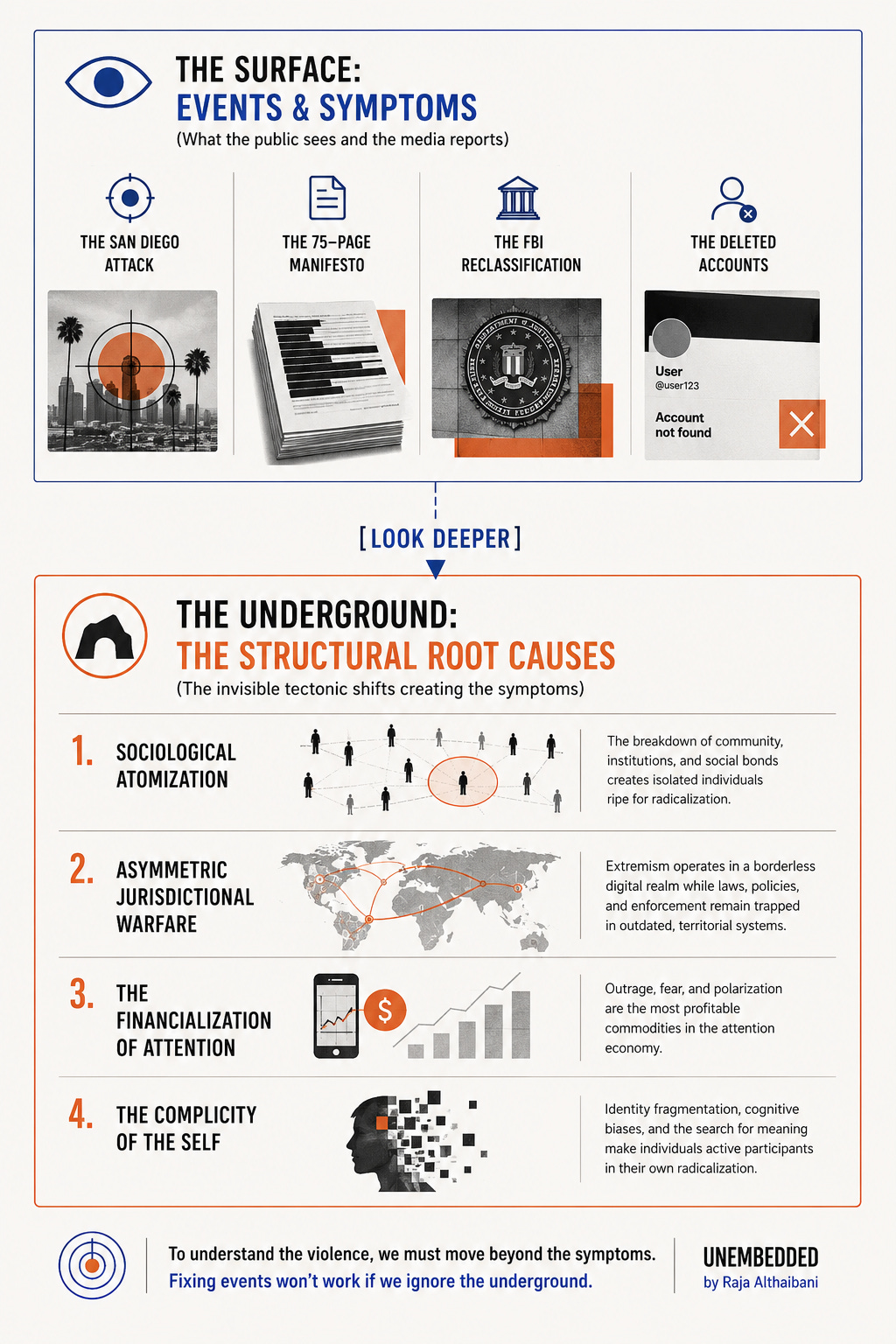
To understand why San Diego happened, we must stop staring at the surface of the water. The pipeline is not built on extremist ideology alone. It is built on four foundational conditions — structural rot that runs far deeper than any manifesto:
I. Sociological Atomization: The systematic breakdown of local community infrastructure, civic spaces, and social cohesion in Western societies has created a massive demographic of lonely, untethered individuals experiencing acute existential drift. Legitimate personal isolation, economic anxiety, and alienation are not met with community care and human connection; instead, they are outsourced to profit-driven digital interfaces, and left to putrefy in online echo chambers that systematically converted personal grievance into collective, violent anti-system rage. Convincing vulnerable individuals that civilizational conflict is their only path to significance.
II. Asymmetric Jurisdictional Warfare & Legal and Governance Atrophy:
The state operates on an obsolete, 20th-century model of geographical borders and physical command chains (think structured cells and top-down organizations). Conversely, modern extremism operates through fluid, borderless hybrid decentralized extremist networks that defy fixed labels and render national legal architectures fundamentally toothless. International frameworks cannot stop cross-border ideological acceleration when the network has no fixed address and no central leadership to surveil.
III. The Financialization of Attention: Under digital capitalism, human attention is the ultimate commodity. Because outrage, fear, and polarization generate the highest engagement metrics, the economic foundations of tech and media are structurally aligned with the mechanics of radicalization. This is compounded by a fundamental fracture within journalism itself: hyper-accelerated timelines force breaking desks to treat attacks as context-free anomalies, while resource limitations strip investigative units of the capital and capacity required to map complex pipelines.
IV. The Complicity of the Self: We must ultimately confront our own role as media consumers, citizens, and communities. We actively feed the attention economy that makes outrage profitable. Sheltered by comforting narratives of exceptionalism, it is easy to point fingers at external villains or passively wait for “the authorities” to fix a broken world. By participating in fractured, hyper-individualistic cultures, we starve the collective accountability and social tissue required to stop the bleeding before it begins.
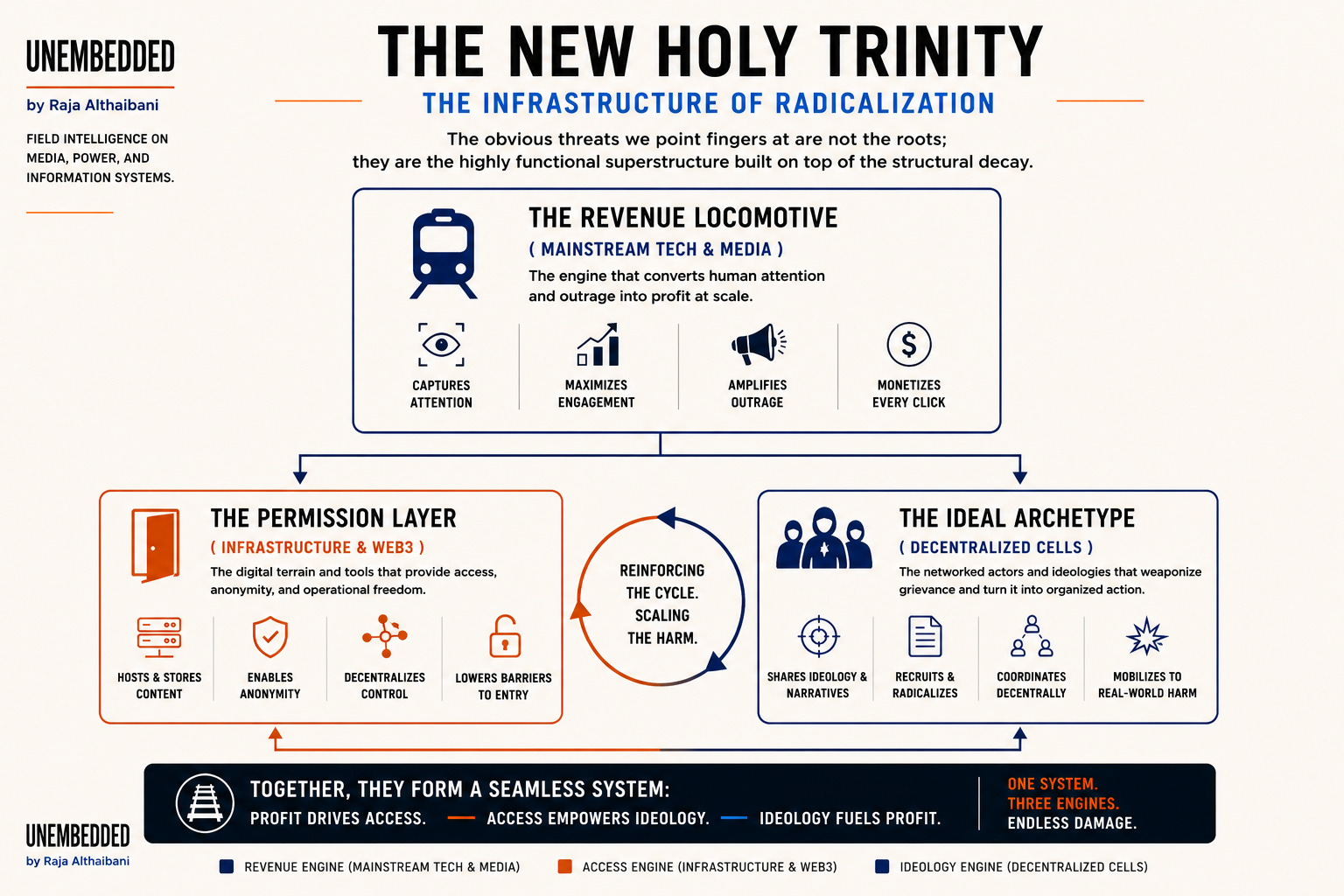
The New Holy Trinity: The Infrastructure of Radicalization
When these four root conditions converge, they give birth to three operational engines: the obvious threats we point fingers at. They are not the roots. They are the highly functional superstructure built directly on top of the structural decay.
I. The Revenue Locomotive (The Optimization Engine):
Operating within a governance vacuum, Big Tech and Corporate Media serve as the front-end funnel. Mainstream algorithms optimize recommendation loops to push isolated people toward extremism, while corporate parents spend millions lobbying to kill transparency bills that would force them to reveal how those loops work. Simultaneously, mainstream outlets package mass casualties into sensationalized, polarizing content because fear drives ad revenue, and fear provides the exact global megaphone the attackers designed their massacres to achieve.
II. The Infrastructure of Permission (The Technical Sub-Layer)
When mainstream platforms issue bans, extremism simply migrates fluidly into a decentralized, unmoderated tech layer that exploits the governance void. It utilizes decentralized, federated networks like Matrix/Element and private Mastodon instances, metadata-free encrypted messaging apps like Session and private Signal forks, anonymous imageboards like 4chan, 8kun, and EndChan, and offshore bulletproof hosting providers. This plumbing ensures their digital infrastructure remains immune to state censorship or legal subpoenas, and keeps the recruitment archive accessible to the next shooter in a bedroom somewhere.
III. The Ideal Archetype (The Cultural Gamification Network)
Decentralized cells and imageboards weaponize hyper-individualism by taking the isolated individuals processed by the Revenue Locomotive and offering them a tribal identity. They explicitly gamify mass murder, turning digital manifestos like The New Crusade into viral marketing collateral with leaderboards and digital trophies, ranking body counts like a video game leaderboard. This closes the loop: transforming the consumer of radical content into the next active producer of violence.
What’s Coming
This is part of Unembedded’s ongoing reporting and analysis on the systems, infrastructures, and power structures that produce political violence, and the people working to dismantle them.
San Diego is the entry point. The machinery it exposed is not local, and the reporting will not stay local.
In the coming weeks and months, we are going deeper into every layer of this infrastructure, through this and other past and current events. That means:
The legal and security architecture: the counter-terrorism protocols, behavioral intervention frameworks, and intelligence-sharing systems that were all active in the Vazquez case, and the documented points at which each one failed. What the law can and cannot do. What it is designed to ignore. What a 20th-century security model looks like when it meets a 21st-century decentralized network.
The tech and platform layer: Cloudflare’s four-year infrastructure relationship with WatchPeopleDie. Meta’s January 2025 content moderation rollback and what the data shows happened after it. The lobbying architecture that killed transparency legislation across ten countries. What the EU’s Digital Services Act is actually doing, and what it can’t touch.
The transnational network: how Christchurch, Buffalo, Bratislava, Nashville, and San Diego are nodes on the same line. The shared canon, the shared playbook, the shared recruitment pipeline. Why this is not an American story, and what that means for practitioners, policymakers, and communities in Europe and beyond.
The policy and accountability gap: the Domestic Terrorism Prevention Act and why it has died in the Senate every session since 2017. What ERPO law can and cannot do about peer networks. What a network-aware intervention framework would actually require. Who is blocking it and what they are protecting.
The cross-community dimension: the San Diego manifesto named Muslim, Jewish, Black, and LGBTQ communities as targets. The movement does not discriminate. Neither should the coalition fighting it. What a joint cross-community advocacy strategy looks like in practice, and who is already building it.
The media and attention economy: how breaking news desks structurally produce the amnesia cycle this piece describes. What responsible coverage of ideological violence actually requires. The outlets and journalists doing it right, and what we can learn from them.
The practitioner, activist, and engaged public tools. Public records request templates (CPRA for California, FOIA for federal). Digital safety guides for parents, educators, and community moderators. Model ERPO reform language for state-level advocates. Christchurch Call resources for civil society organizations engaging international frameworks. City council comment scripts. Shareholder action guides for institutional investors with human rights mandates. Scripts for talking to your kids, your neighbors, your elected officials, and your school board. Guides for recognizing radicalization early: in your home, your classroom, your community center, your mosque, your church, your synagogue. How to report, who to call, what actually happens when you do. And the full cross-community action playbooks/ tip sheets: concrete, specific, and written for everyone from the policy veteran to the parent who just found something disturbing on their teenager’s phone. Not awareness. Actionable.
We will not move on. That is the commitment.
The system flagged Caleb Vazquez sixteen months before the attack. It removed 26 guns from his home. It marked the file resolved. And it never saw Cain Clark coming, because the two of them built toward the same endpoint in digital spaces the architecture was never designed to watch.
That is where we go next.

About the Author
Raja Althaibani works at the intersection of media, harm, technology, and accountability—advising, training, investigating, and building infrastructure for practitioners navigating an information landscape that moves faster than most frameworks can follow. Her background spans human rights, journalism, international law, and open-source digital documentation.
She writes Unembedded—long-form analysis, reported essays, and field frameworks on media, power, harm, and who controls the story. It includes two ongoing series: The Safari Is Over, on how media covers harm and what better practice looks like, and The Field Dispatch, the intelligence arm of The Field—a community of practice she founded.
Work with Raja: inquiries@rajaalthaibani.com · contact form · www.rajaalthaibani.com · Linkedin
Militant accelerationism is inherently global. Attackers across continents, from Christchurch (New Zealand) to El Paso and Buffalo (United States) to Halle (Germany), explicitly cite, translate, and build upon one another’s actions.
The network relies on a fixed canon of foundational text: ideological blueprints like James Mason’s Siege, a growing archive of past attackers’ digitized manifestos treated as sacred doctrine, and reference materials designed for distribution and translation across language communities.
The operational methods are highly standardized: live-streaming mass casualty events, writing manifestos structured to maximize media amplification, utilizing specific memes and symbols, and gamifying violence by ranking body counts.