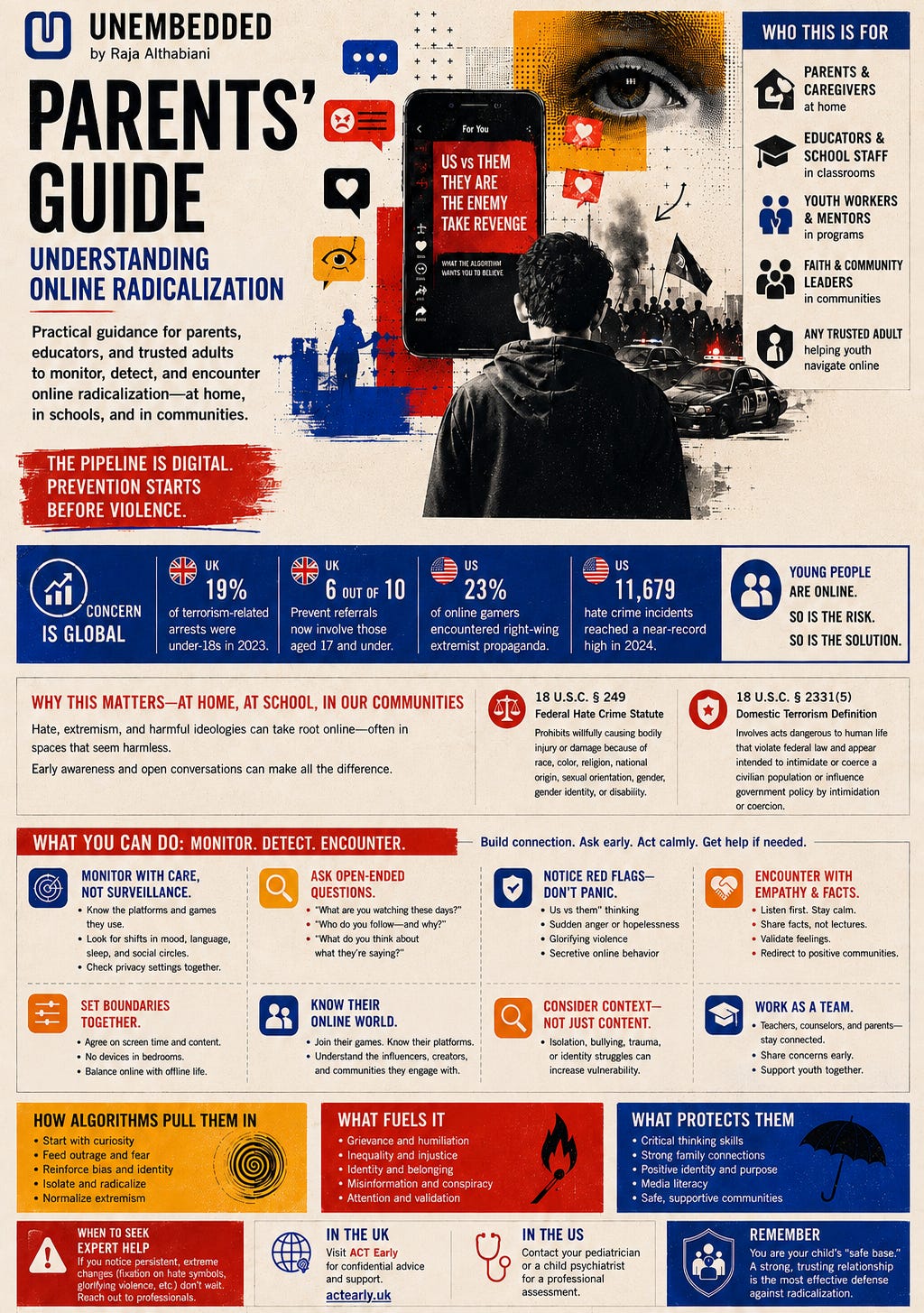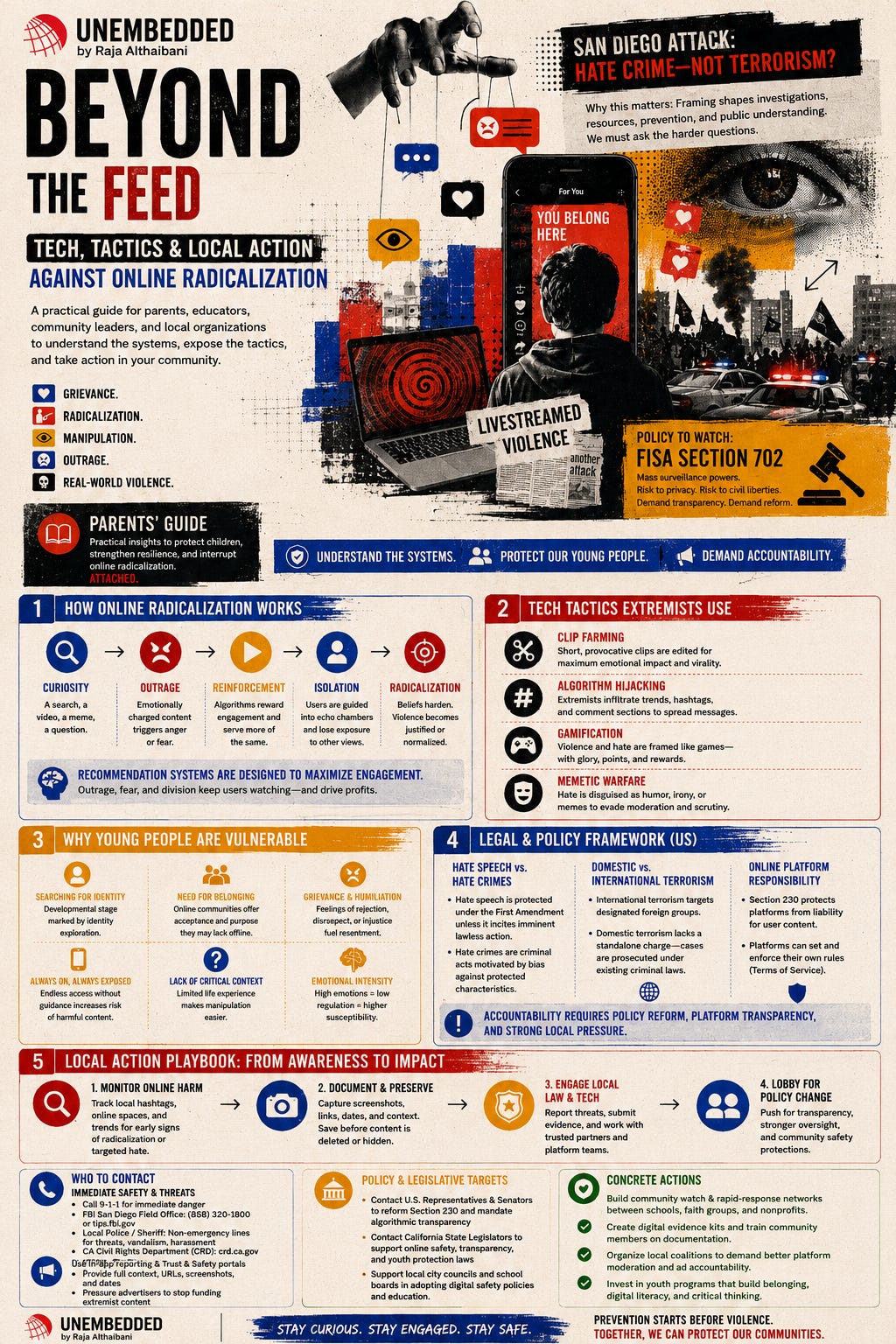


Are you worried about what your children, students, friends, or community are being exposed to online right now?
The teenage gunmen who carried out Monday’s deadly attack at the Islamic Center of San Diego did not radicalize in a vacuum.
They were shaped by systems, and manufactured by design.
While communities mourn the lives of Amin Abdullah, Mansour Kaziha, and Nadir Awad, commentators keep asking:
How does this keep happening?
The urgent question is:
How do we expect to protect young people from online radicalization while ignoring the algorithmic systems, dehumanizing political language, grievance economies, and engagement-driven infrastructures that normalize extremism in the first place?
The infrastructure of modern violence has fundamentally changed.
What once lived in fragmented corners of the internet is now embedded into everyday digital life, reaching children earlier, faster, and more intimately than ever before.
It connects seemingly disparate horrors: ISIS propaganda networks, the Christchurch mosque livestream, antisemitic synagogue attacks, and the rising global surge of femicide and targeted misogyny.
For years, Western institutions treated these threats as distant, fringe, or external. Domestic extremism was minimized, selectively labeled, or politically compartmentalized while the underlying systems continued expanding in plain sight.
Today, state actors, influencers, extremist networks, and platform economies increasingly exploit the same vulnerabilities: fear, isolation, humiliation, identity crises, discrimination, and social alienation.
The pipeline is digital, and its consequences are physical.
So I created this tip sheet not as a panic document, but as a practical starting point for parents, educators, journalists, organizers, and communities trying to understand what is actually happening around them, and what warning signs we can no longer afford to ignore.
This is only the beginning.
In the coming weeks, Unembedded will continue publishing:
practical prevention guidance
platform accountability analysis
newsroom reporting frameworks
policy pressure points
school and community intervention strategies
investigations into the systems shaping modern online radicalization
Prevention starts long before violence. It starts with understanding the systems shaping attention, identity, belonging, and belief.
Subscribe to Unembedded, and restock and share this with your networks.
Please note: the guidance and frameworks shared through Unembedded will continue evolving as technologies, platforms, policies, and online behaviors rapidly change. Stay subscribed for updated analysis, corrections, resources, and future action frameworks.
— Raja Althaibani, Editor, Unembedded